
Approvals and handoffs
Route requests to the right person, send reminders and record decisions. Give each stage an owner so work does not get lost between inboxes.
Remove repetitive steps from everyday work with workflows that are clear, reliable and easy to oversee. SourceLayer helps connect your tools, process incoming information and use AI where it supports a real business need.
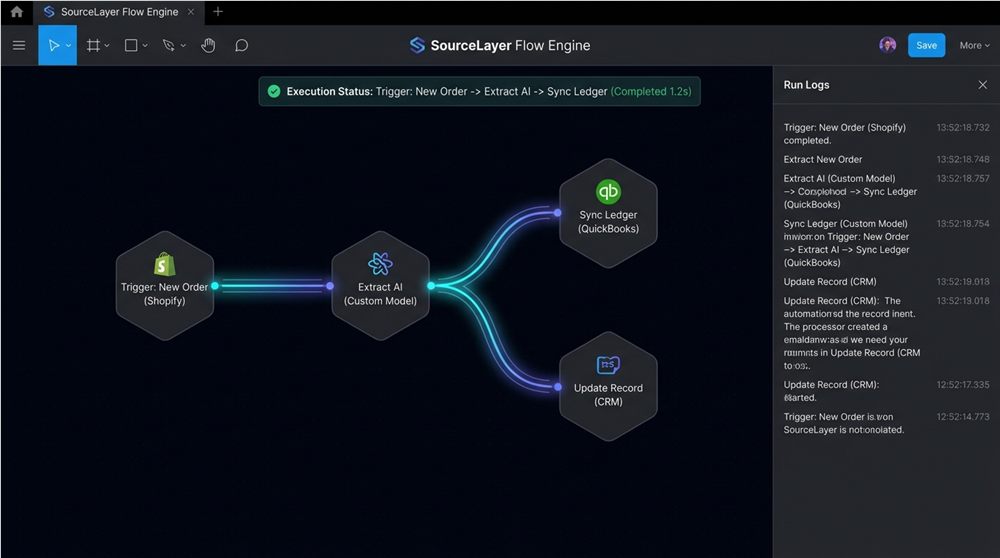
A useful automation starts with a repeatable process. We identify the steps that can run consistently, the decisions that need a person, and the exceptions that must stay visible.
Route requests to the right person, send reminders and record decisions. Give each stage an owner so work does not get lost between inboxes.
Capture enquiries, create follow-up tasks and guide new customers through the information you need. Keep your team informed without repeated copying and chasing.
Extract relevant fields from invoices, forms and other documents. Validate the results and send uncertain items for review before they update another system.
Help staff find approved information, summarise material and prepare drafts. Define which sources the assistant can use and when it should hand a question to a person.
Send useful updates when work changes state and prepare recurring summaries. Reduce manual reporting while keeping important exceptions visible.
Add classification, summarisation or drafting to an established workflow. Choose a focused use case with clear quality checks before extending it further.
Not every step should be automated. We first understand your current process, available data, approvals and the cost of a mistake. A clear rule may be more appropriate than AI for a predictable task.
Where AI is useful, we agree the source material, access limits and review criteria. The workflow should make uncertain results visible and provide a way to continue when an external service is unavailable.
A supplier document arrives, relevant fields are extracted, and basic checks flag missing or uncertain values. A team member reviews exceptions before approved information moves to the next system. This is an example workflow; the final steps depend on your process and software.
Staff copy the same information between forms, email and business tools.
Approvals stall because nobody knows whose action is needed next.
Your team spends time reading and classifying similar documents.
Follow-ups depend on someone remembering to send a message.
People repeatedly ask for information already held in your documents.
Reports take hours to assemble from otherwise available information.
Map the process, people, exceptions and expected outcome.
Agree triggers, approvals, access and a useful first workflow.
Connect the tools and introduce checks at each handoff.
Test representative inputs, errors and human review paths.
Review results and refine the workflow before expanding it.
Often you can keep it. We first check the tools, APIs and permissions available, then identify where a connection or a small supporting tool is enough.
No. Rules and standard integrations are often more predictable. AI is considered for tasks such as understanding unstructured text, with review appropriate to the consequences of an error.
Start with a repeated task that has clear inputs, an identifiable owner and an outcome you can measure. We agree a manageable scope before building.
Tell us about the process, the tools involved and where work slows down. We can help define a useful first automation and the checks it needs.